


If you're still running the same SEO playbook you used in 2022, researching keywords, writing blogs, building backlinks, you're not doing anything wrong. But you might be playing an incomplete game.
Because in 2026, the question isn't just "How do I rank on Google?"
It's also "How do I show up when someone asks ChatGPT?" and "What does Google's AI Overview say about my brand?"
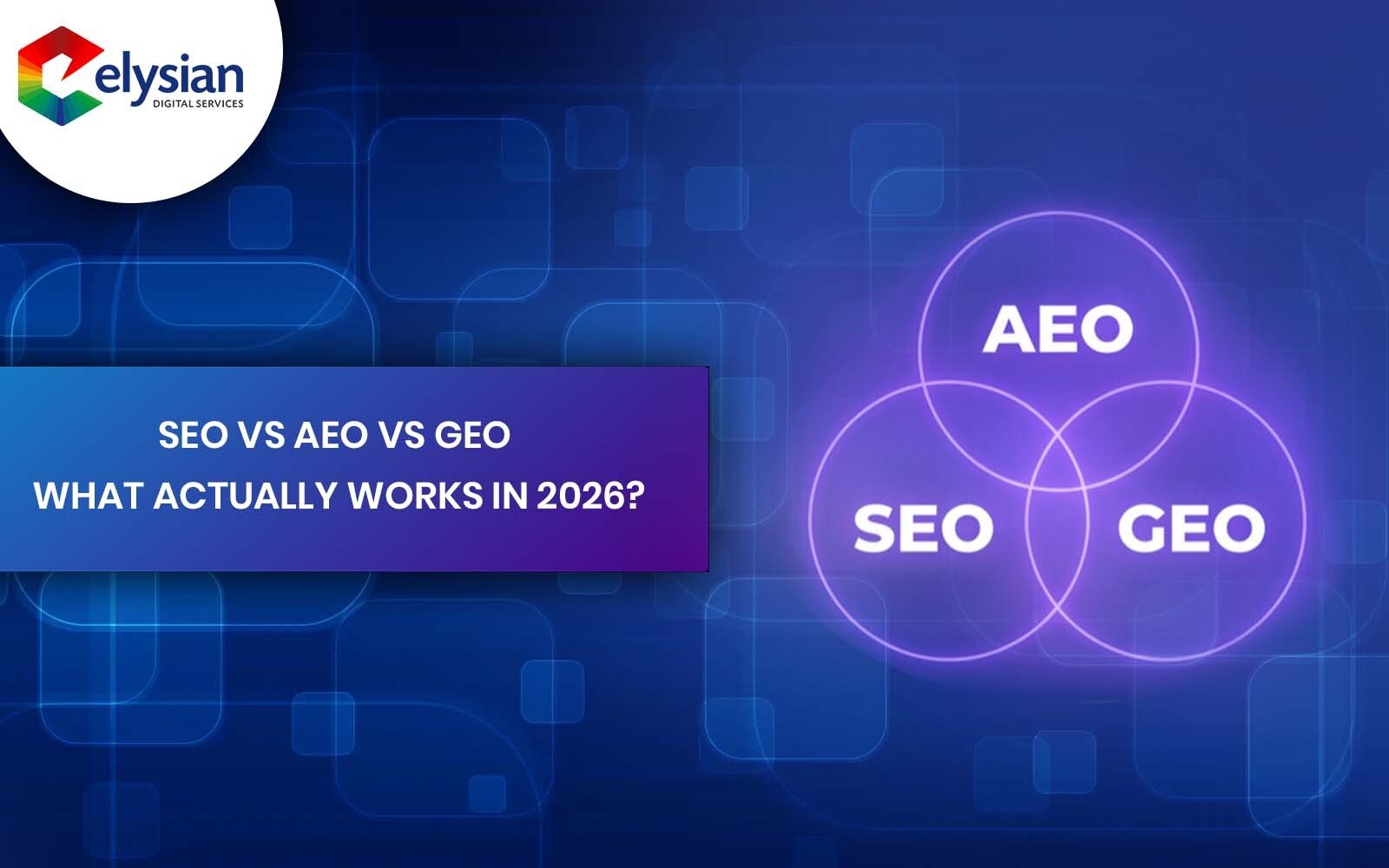
That's where three strategies come in: SEO, AEO, and GEO.
They're not competitors. They're not buzzwords designed to confuse you. They're the three layers of modern search, and if you understand how they work together, you'll be ahead of 90% of businesses still trying to figure it out.
Let's break it all down, clearly and without the jargon fog.
The numbers make this impossible to ignore.
ChatGPT now processes 2.5 billion prompts every single day, and 65% of them are essentially search queries. Google's AI Overviews have pushed traditional blue links further down the page, causing a 58% drop in click-through rates for content that used to rank at the top.
Meanwhile, 31.3% of the US population is expected to use generative AI search tools in 2026, according to EMARKETER. And AI-driven traffic, though smaller in volume, converts at 4.4 times the rate of regular organic search visitors.
Here's the uncomfortable truth: if you're only optimizing for traditional Google rankings, you're optimizing for yesterday's internet.
Now, let's understand what you should be doing instead.
SEO, Search Engine Optimization is the practice of making your website rank higher in traditional search results. It's the thing most of us have been doing for years.
At its core, SEO has three pillars:
Technical SEO covers the behind-the-scenes stuff, site speed, mobile-friendliness, clean URL structure, SSL security, XML sitemaps. Think of it as the plumbing. Nobody notices it when it works. Everyone notices when it breaks.
On-Page SEO is about what's actually on your page, keyword placement, heading structure, meta tags, content quality, image alt text, internal links. This is what you're controlling directly.
Off-Page SEO is about authority, backlinks from other respected websites, brand mentions, social signals. This is Google's way of asking: "Does the internet vouch for this page?"
No. Not even close.
Here's a stat that should settle this once and for all: 76% of Google AI Overview citations come from pages that are already in the top 10 organic results. A study by Lily Ray found that when sites lost organic rankings, their ChatGPT citations dropped by 27.8%.
In other words, SEO is the foundation that AEO and GEO are built on. You can't skip it.
What's changed is that SEO alone is no longer enough. It gets you into the game. The next two strategies determine whether you win.
AEO (Answer Engine Optimization) is the practice of structuring your content so it gets pulled directly as an answer. Think featured snippets, Google's "People Also Ask" boxes, voice assistant responses, and the extracted summaries you see in AI Overviews.
The goal of AEO isn't to get a click. It's to be the answer.
Someone searches "what is the best time to post on Instagram?" A well-AEO-optimized page doesn't wait for the user to click through, it gives Google everything it needs to surface a direct answer, right on the results page.
Write for questions, not just keywords. Instead of just targeting "email marketing tips," think about what questions your audience is actually asking: "How often should I send marketing emails?" "What's a good email open rate?" These conversational queries are exactly what AI systems are scanning for.
Lead with your answer. AEO content follows a clear format: question as a heading, direct concise answer in the first two sentences, then supporting detail below. The answer itself should be 40–60 words, short enough for a voice assistant to read aloud without losing the listener.
Add FAQ schema markup. This is the technical bridge between your content and how AI systems read it. When you mark up your Q&A sections with FAQPage schema, you're essentially handing Google a neatly labeled package and saying: "Here. This is the answer. Use it."
Use clean structure. Numbered lists, bullet points, tables, clear H2 and H3 headings, these aren't just for human readers. AI systems parse content the way a very literal reader would. Clear structure = cleaner extraction.
The payoff? Visitors coming through AEO-optimized content convert at significantly higher rates, because they already found their answer, and your brand delivered it.
GEO, Generative Engine Optimization, is the newest layer, and the one most businesses are still ignoring.
Where AEO focuses on being extracted as an answer, GEO focuses on being cited as a source by tools like ChatGPT, Perplexity, Google Gemini, and Claude when they synthesize a response.
Here's the shift in mindset that GEO requires:
With traditional SEO, a human visits your page. With GEO, an AI reads your page and decides whether to reference it.
The AI isn't scanning for keywords. It's looking for content that is factually reliable, structurally clear, and backed by authority signals that match what other trusted sources are saying.
Fact density over fluff. AI systems are trained to prefer content with verifiable claims, specific statistics, and named sources. An article saying "email marketing has a high ROI" will lose to one saying "email marketing delivers an average ROI of 36:1, according to Litmus's 2025 State of Email report." Be specific. Be citable.
Original data is gold. If you've run a survey, analysed your client results, or compiled industry data, publish it. AI models love citing primary sources. Even a small-scale study on your own clients makes you a more attractive reference than a page that just summarises what others have said.
Build presence on Reddit, LinkedIn, and YouTube. This may surprise you, but in October 2025, Reddit, LinkedIn, and YouTube were among the most-referenced domains by major language models. AI systems don't just read your website, they read the broader conversation around your brand. Having genuine, helpful contributions in these spaces matters.
Freshness is a citation ranking factor. Research by AirOps found that content updated within the past 10 months accounts for 95% of all ChatGPT citations. Stale content, even if it ranks on Google, may be invisible to AI. Update your key pages regularly, add new data, refresh examples, update statistics.
Entity clarity across the web. AI systems piece together your brand identity from multiple sources. If your website says one thing, your LinkedIn says another, and your Google Business Profile is incomplete, the AI gets a confused picture, and uncertain sources don't get cited. Consistent, clear brand messaging across all platforms is now an SEO strategy.
| SEO | AEO | GEO | |
|---|---|---|---|
| Goal | Rank in search results | Be the direct answer | Be cited by AI |
| Primary Platform | Google, Bing | Google Snippets, Voice, AI Overviews | ChatGPT, Perplexity, Gemini |
| Success Metric | Rankings + organic traffic | Featured snippets, zero-click impressions | AI citations, brand mentions in AI answers |
| Key Tactic | Keywords, backlinks, technical | Question-format content, FAQ schema | Fact density, entity clarity, original data |
| Content Format | Long-form, keyword-rich articles | Q&A format, concise answer-first paragraphs | Data-backed, citation-ready, structured content |
| Authority Signal | Backlinks | E-E-A-T + structured data | Web consensus, freshness, cross-platform presence |
Here's the mental model that changes everything:
SEO gets you into the room. AEO gets you on stage. GEO gets you quoted.
None of these strategies replaces the others. They compound. The content authority you build through SEO is exactly what makes AI systems trust your content enough to cite it. The answer-first structure you create for AEO is the same structure that makes your content easy for generative AI to extract and reference.
Think of a single well-optimised piece of content:
That's three visibility touchpoints from one piece of content. That's what integrated search strategy looks like in 2026.
Publishing volume without structure. More blog posts ≠ better AI visibility. Research consistently shows that ten well-structured, fact-dense, schema-marked pieces outperform a hundred keyword-stuffed articles in AI citation rates. Stop producing content and start engineering it.
Ignoring author credentials. AI systems and Google's E-E-A-T framework both favour content with clear authorship and demonstrated expertise. Publishing everything under a generic "Admin" account with no bio, no credentials, and no professional profile is quietly killing your authority signals.
Only tracking rankings and traffic. If AI tools are surfacing your content without sending a click, your traffic metrics look flat while your actual visibility is growing. Start tracking AI citation share, how often does your brand appear in ChatGPT or Perplexity responses in your category?
Treating each strategy in isolation. Businesses that win in 2026 aren't choosing between SEO, AEO, and GEO, they're integrating all three into every piece of content they create. A Practical 2026 Content Framework
Here's how to put this into practice for your next piece of content:
Step 1 : Start with search intent (SEO).
What is the user actually trying to accomplish? Target a primary keyword, but write for the human behind the search, not just the algorithm.
Step 2 : Add an answer-first opening (AEO).
Within your first 100 words, answer the core question directly and completely. Put this in a visually distinct box or use an H2 framed as a question. Add FAQ schema markup to your Q&A sections.
Step 3 : Load it with verifiable substance (GEO).
Include at least 3–5 specific statistics from named, credible sources. Add your own observations or data from client work. Cite your sources with links. Make your content the kind of thing an AI would be confident quoting.
Step 4 : Update it regularly.
Set a 6-month reminder to revisit key content pieces, refresh statistics, add new examples, and update any outdated references.
SEO is not dead. It's the prerequisite.
AEO is not new, it's just SEO with better manners for AI systems.
GEO is not a replacement, it's the frontier where brand authority meets AI visibility.
The businesses that are winning search in 2026 are not the ones who chose the right acronym. They're the ones who understood that search has always been about being genuinely useful, and then structured their content so that both humans and AI systems can easily recognise that usefulness.
If you're ready to build a search strategy that works across Google, AI Overviews, and generative AI tools, that's exactly what we do at Elysian Digital Services. Explore our SEO services or get in touch with our team to talk about where your digital presence stands today.
Q: What is the difference between SEO, AEO, and GEO?
SEO (Search Engine Optimization) helps your pages rank in traditional search results like Google. AEO (Answer Engine Optimization) structures your content to be featured as a direct answer in snippets and AI Overviews. GEO (Generative Engine Optimization) optimises your content to be cited as a trusted source by AI tools like ChatGPT, Perplexity, and Google Gemini.
Q: Is SEO still relevant in 2026?
Yes, absolutely. SEO remains the foundation of all search visibility. Research shows that 76% of Google AI Overview citations come from pages already ranking in the top 10. Strong organic rankings are a prerequisite for AI citation — not a replacement for it.
Q: How do I optimise content for AI Overviews and ChatGPT?
Focus on three things: (1) answer questions directly in the first 1–2 sentences of each section, (2) include specific statistics and cite your sources, and (3) use structured formatting with clear headings, bullet points, and FAQ schema markup.
Q: What is GEO and how is it different from AEO?
AEO focuses on getting your content extracted as a featured snippet or voice search answer. GEO focuses on getting your brand cited by AI tools when they synthesise a full response. In 2026, the two strategies overlap significantly, the same structured, authoritative content performs well in both.
Q: Do I need to choose between SEO, AEO, and GEO?
No. The most effective approach integrates all three. SEO builds your authority and rankings. AEO captures direct-answer placements. GEO earns AI citations. Together, they give your content multiple points of visibility across traditional and AI-powered search.
Q: How often should I update my content for GEO?
At least every 6 months for evergreen content. Research by AirOps found that 95% of ChatGPT citations come from content updated within the last 10 months. For fast-moving topics, quarterly updates are worth the effort.
Q: Can a small business compete in AEO and GEO?
Yes, and often more effectively than large brands. AI systems prioritise content quality, specificity, and authority signals over brand size. A small agency with well-structured, data-backed, regularly updated content can outcompete a large corporation with outdated or generic pages.
Learn more about the expert behind this content and their industry experience.

Bijendra Thakur is an SEO Specialist with 7+ years of experience in driving organic growth and dominating search rankings. He specializes in on-page, technical SEO, and advanced content strategies that improve visibility and generate high-quality leads. Bijendra has successfully helped businesses rank on Google’s first page, boost traffic, and achieve long-term results through data-driven SEO techniques.
Discover tailored digital marketing solutions designed to boost your visibility, increase ROI, and support your business growth. Connect with our experts today.
Get In Touch