


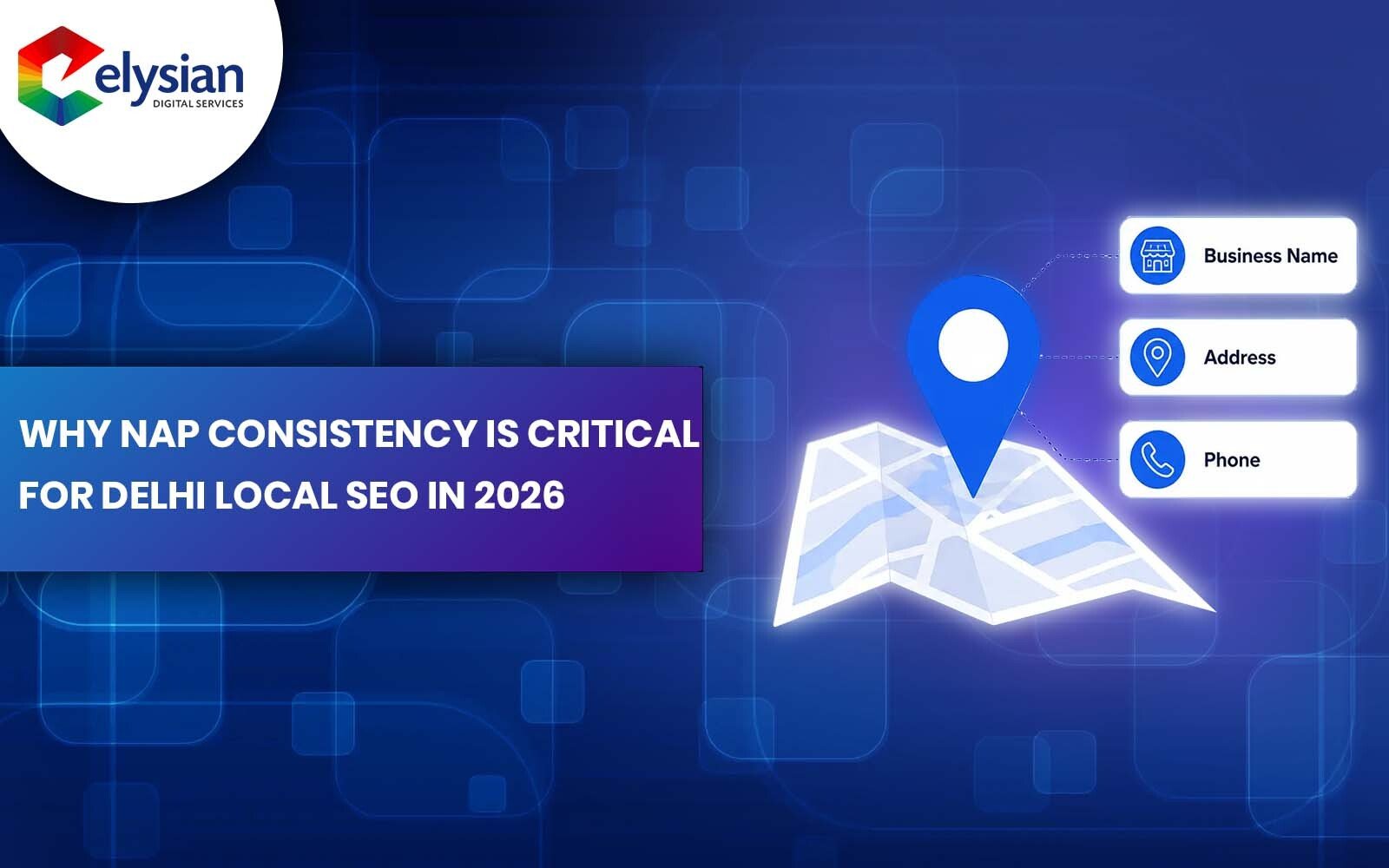
If your Delhi business has different names, addresses, or phone numbers across Google, your website, Justdial, IndiaMART, social profiles, and other directories, you are creating conflicting business signals. NAP consistency, Name, Address and Phone consistency, helps search engines and customers understand that those listings refer to the same real-world business.
At Elysian Digital Services, we treat NAP accuracy as a foundational part of our Local SEO Services rather than a one-time directory submission exercise. When we onboard local Delhi businesses, we first compare the business information across Google Business Profile, the website, major directories, social profiles and other relevant local references before deciding where citation work is actually required.
Google itself states that businesses should represent themselves consistently as they are represented in the real world and that their address and service area information should be accurate.
NAP stands for Name, Address and Phone, and NAP consistency means keeping these core business details accurate and appropriately consistent across the web. For Delhi businesses, this includes your Google Business Profile, website, local directories, social profiles and other authoritative business references.
A simple example:
| Business Information | Correct Version |
|---|---|
| Name | Elysian Digital Services |
| Address | Office 123, Sector XX, Gurugram, Haryana |
| Phone | +91-XXXXXXXXXX |
| Website | elysiandigitalservices.com |
| Service Area | Delhi NCR |
The problem begins when different platforms show variations such as:
Not every variation is automatically harmful, and NAP does not mean every character must be identical in every legitimate context. The objective is to make the business identity clear, accurate and supported by real-world information.
Google specifically requires the business name to reflect the real-world name used on signage, stationery and branding rather than adding unnecessary keywords or promotional phrases.
NAP consistency matters because accurate business information makes it easier for Google and users to associate different online references with the same legitimate business. For Delhi businesses competing in crowded local search results, inaccurate contact information can also create customer trust and conversion problems.
Delhi has an unusually competitive local search environment across sectors such as:
A prospect searching for "SEO agency near me," "dentist in South Delhi," or "interior designer in Gurgaon" expects the business information they find to be reliable. If you'd like to see how this plays out for "near me" queries specifically, we've covered it in detail in How to Rank for "Near Me" Searches in Delhi 2026.
If Google shows one phone number while your website shows another, a directory displays an old address and your social profile uses a different business name, the customer has to resolve the contradiction themselves. That is unnecessary friction.
Google also explains that information shown in local results can come from multiple sources, including the business's website, public information, third-party data and user contributions.
NAP consistency should not be treated as a guaranteed direct ranking factor with a simple "consistent = higher ranking" formula. Its practical importance is that accurate and trustworthy business information supports Google's understanding of the business and improves the reliability of local search information.
This distinction is important. A business cannot simply create hundreds of identical directory listings and expect rankings to increase automatically. Modern local SEO requires much more than citation volume.
Your local search presence depends on a broader combination of factors, including:
Google says local results are influenced by information it receives from the business as well as other sources across the web. Ahrefs' research on local ranking factors also notes that citations remain a meaningful, if declining, signal compared to reviews and on-page relevance.
So our recommendation at Elysian Digital Services is simple: don't chase citation quantity. Build a clean, accurate and trustworthy local entity.
For most Delhi businesses, the first priority is to audit the business name, physical/service-area information and primary phone number across the most important online properties. Your website and Google Business Profile should be the starting point, followed by relevant directories and third-party references.
Your business name should represent the actual business. Avoid artificially adding:
Better: ABC Dental Clinic Risky: ABC Dental Clinic Best Dentist in Delhi | Cheap Dental Treatment
Google's guidelines specifically prohibit adding unnecessary information such as marketing taglines, phone numbers, URLs or other unrelated details to the Business Profile name.
The address should accurately represent the real-world business location when the business is eligible to display an address. A Delhi business shouldn't casually use an old office, virtual office, incomplete address or a different branch address simply because it is closer to a target keyword.
Check:
For example, don't randomly switch between "Sector 44, Gurugram" and "Sector 44, Gurgaon" just because one version appears in an old directory.
Google recommends using a precise, accurate address and prohibits virtual-office addresses for businesses that don't actually operate there.
Your primary business phone should connect directly to the business and should be kept accurate across important local profiles. Old numbers are particularly problematic when potential customers use them to contact your business.
Audit:
Google recommends using a local phone number instead of a central call-centre number whenever possible and says the number should be under the direct control of the business.
NAP consistency means your business information is appropriately aligned across important sources, while NAP accuracy means the information itself is actually correct. Accuracy should come first because consistently repeating incorrect information only spreads the wrong data.
Consider a Delhi company that moved from Lajpat Nagar, Delhi to Okhla Phase II, Delhi. If 40 old directories still display the previous address, creating 20 more listings with the old address doesn't solve the problem.
The correct workflow is:
This approach is significantly more useful than simply measuring SEO work by the number of directories submitted.
The biggest risks of inconsistent NAP data are confusion, outdated customer information, weaker local trust signals and wasted local SEO effort. The impact is particularly obvious when incorrect information reaches high-visibility properties such as Google Business Profile, Maps or major directories, a problem we've also broken down in Why Your Delhi Business Isn't Showing in Google Maps (And How to Fix It).
Common problems include:
Customer confusion : A prospect may call an outdated number or visit an old address.
Duplicate business identities : Multiple versions of the same business can create unnecessary ambiguity.
Lost leads : A wrong phone number can turn a search impression into a missed enquiry.
Poor user experience : Customers expect Google, your website and directories to provide the same basic business information.
Local SEO inefficiency : Your SEO team may spend time building new citations while important historical errors remain unresolved.
Brand credibility issues : A business with five different addresses across the web can appear less established than one with a clear and consistent digital footprint.
Most NAP problems are not caused by one major technical error; they usually come from old listings, inconsistent formatting, business relocations, duplicate profiles and changes that were never propagated across the web. For a wider look at recurring SEO issues beyond NAP, see Top 10 SEO Mistakes Delhi Businesses Make (And How to Fix Them).
In our agency workflows, common problems include:
Google provides specific rules for storefront and service-area businesses, including when an address should be displayed or hidden.
A proper NAP audit starts with a master business record and then compares that information against the company's most important online references. The goal isn't to find every website on the internet; it's to identify discrepancies that can materially affect trust, visibility or customer conversion.
Document your official business name, correct address, primary phone, website, business category, branch information, service areas, and opening hours. This becomes the reference version for the audit.
Google Business Profile should be one of the first properties checked because it directly supports a business's presence on Google Search and Maps. Verify the business name, address, phone, category, website and service-area information. For a full walkthrough of getting this right end-to-end, see our Google Business Profile Optimization Guide for Delhi Businesses in 2026.
Google allows businesses to update information such as address, hours, phone number and photos, although changes can be reviewed before they become live.
Check: business name, primary category, address, map pin, phone, website, hours, service area, and duplicate profiles.
Your website should provide an obvious and authoritative source of current business information. Check the header, footer, contact page, location pages and structured data for outdated details.
Pay special attention to:
For multi-location businesses, every location page should clearly identify the correct branch. If your website itself needs a refresh to properly display this structured information, our Website Designing team can rebuild your contact and location pages alongside the SEO fix.
Prioritise important and relevant directories rather than attempting to create listings on every available website. Ahrefs' guide to building local citations is a useful reference if you want to understand the different citation types before starting outreach.
Depending on the business, audit relevant platforms such as:
The correct citation mix depends on the industry. A restaurant and a B2B SaaS company do not need the same directory strategy.
Use this checklist before launching or refreshing a Delhi local SEO campaign.
| NAP Element | What to Check | Priority |
|---|---|---|
| Business Name | Real-world business name | High |
| Address | Current physical location | High |
| Phone | Direct and current number | High |
| Google Business Profile | Name, address, phone and category | Critical |
| Website | Contact details match current information | Critical |
| Map Pin | Correct physical location | High |
| Service Area | Accurate areas served | High |
| Social Profiles | Current business information | Medium |
| Major Directories | Correct NAP | High |
| Industry Directories | Correct NAP | Medium |
| Old Listings | Update/remove where possible | High |
| Duplicate Profiles | Identify and resolve | Critical |
Basic NAP cleanup in Delhi can range from a few thousand rupees for a small business to significantly more for multi-location businesses with hundreds of historical listings. The actual cost depends primarily on the number of locations, number of citations, duplicate listings and the amount of manual correction required.
A practical budgeting framework is:
| NAP Work | Typical Delhi 2026 Budget* |
|---|---|
| Basic NAP audit | ₹3,000–₹7,500 |
| Small-business citation cleanup | ₹5,000–₹15,000 |
| Comprehensive local citation cleanup | ₹10,000–₹30,000+ |
| Multi-location NAP audit | ₹20,000–₹50,000+ |
| Ongoing local SEO management | ₹15,000–₹50,000+ / month |
| Enterprise/multi-location work | Custom pricing |
*These are indicative agency budgeting ranges, not fixed market rates. Actual pricing varies by business size, citation volume, locations, industry and the amount of manual work involved.
At Elysian Digital Services, we prefer auditing the existing footprint before recommending a package. If a business has only 15 meaningful citations and three contain errors, selling a massive citation-building campaign would not necessarily be the best use of its budget.
Multi-location businesses need a location-level NAP system because every branch can have its own legitimate address and phone number while still belonging to the same brand. A single incorrect branch phone number can create confusion across Google, directories and the company's own website.
For example:
| Branch | Name | Address | Phone |
|---|---|---|---|
| South Delhi | Brand Name | Location A | Number A |
| Noida | Brand Name | Location B | Number B |
| Gurugram | Brand Name | Location C | Number C |
| Ghaziabad | Brand Name | Location D | Number D |
The brand name can remain consistent while branch-specific address and phone information naturally differs. Google also provides specific guidance for chains and multiple locations, including maintaining consistent naming and category practices across locations.
Yes, but service-area businesses need to handle addresses differently from storefront businesses. If a business does not receive customers at its physical address, displaying a residential or virtual address simply to target a Delhi location can create compliance problems.
Examples include plumbers, electricians, home cleaning companies, pest control services, mobile repair services, some consultants, and certain professional services.
Google states that service-area businesses can hide their physical address and instead specify their service areas when appropriate. The objective is not to manufacture a Delhi location, it is to accurately represent where and how the business operates.
Google Business Profile should be treated as part of a wider local entity, not as an isolated listing that can be optimised independently from the website and other business references. Google says it combines information from business owners, public web content, third parties and user contributions when generating information about local businesses.
That makes consistency useful beyond simple directory SEO. For example, if your website says one thing, Google says another, an industry directory says something else, and users continue submitting conflicting information, you have a data-quality problem.
Local SEO therefore needs an ongoing information-management process, which is why we treat GBP health, reviews and NAP as one connected system, see our related guide on How to Get More Google Reviews for Your Delhi Business for the reputation side of this.
Fixing NAP inconsistencies is important, but NAP cleanup alone will not make a Delhi business rank at the top of Google Maps. Strong local SEO combines accurate business information with relevance, useful website content, reviews, local authority, technical optimisation and a properly managed Google Business Profile.
A broader Delhi local SEO strategy may include:
If you're unsure whether local SEO or a broader national approach fits your business, our comparison in Local SEO vs National SEO: Which One Should Your Business Choose? walks through the decision.
For businesses that also need a stronger website foundation, our Website Designing service can be integrated with the local SEO strategy rather than treating the website and Google Business Profile as separate projects. Similarly, businesses requiring ongoing search-focused content can combine local SEO with our Content Writing service to build useful location and service pages, and pair organic growth with our PPC Ads / Google Ads service for faster visibility while citations and rankings mature.
NAP consistency describes the accuracy and alignment of core business information, while a local citation is a place where that business information is mentioned online. A citation can exist without being valuable, so businesses should prioritise relevance and accuracy over raw citation numbers.
Citation = where your business information appears. NAP consistency = whether the core information is reliable and appropriately aligned.
For example, a relevant Delhi industry directory containing your correct business information may be more useful than dozens of low-quality websites containing outdated information.
Our approach starts with diagnosis rather than selling a fixed number of directory submissions. We first establish the correct business information, identify meaningful inconsistencies and then prioritise fixes according to business impact.
Our workflow generally follows:
Local SEO works best when the website, organic search strategy and paid marketing all use the same business identity and conversion information. In practice, inconsistent contact information can create confusion even when traffic comes from channels other than Google Maps.
For example, if Google Ads sends a potential customer to a landing page containing an old phone number, the problem is no longer purely an SEO issue.
That is why local SEO audits should sometimes be connected with website development, content marketing, PPC campaigns, social media marketing, and reputation management.
Businesses looking to connect local SEO with paid acquisition can also evaluate our PPC Ads / Google Ads service as part of a broader lead-generation strategy.
If resources are limited, fix the highest-impact inconsistencies first instead of trying to correct every online mention simultaneously.
This order gives a business a more practical path toward improving its local digital footprint.
A business can perform a basic NAP health check in less than an hour by comparing its Google profile, website and most visible directory listings. If three or more authoritative sources contain conflicting business information, a deeper citation audit is worth considering.
Search for:
Check whether the same business identity appears consistently. Also search "Old Phone Number" and "Old Business Address", these searches can uncover forgotten listings that normal branded searches may miss.
Does NAP consistency still matter for local SEO in 2026?
Yes, accurate and consistent business information remains important for local search data quality and customer trust. However, NAP consistency should be treated as one component of a broader local SEO strategy rather than a standalone ranking shortcut.
What does NAP stand for?
NAP stands for Name, Address and Phone. These are the core business identity details commonly used when auditing local citations and business listings.
Is NAP consistency a direct Google ranking factor?
There is no simple public Google formula stating that NAP consistency directly increases rankings by a specific amount. Its practical importance comes from maintaining accurate business information across Google's ecosystem and other sources.
How often should a Delhi business perform a NAP audit?
At minimum, perform an audit after any major business-information change and periodically as part of ongoing local SEO maintenance. Relocations, phone-number changes, rebranding and new branches are strong reasons to audit immediately.
Does NAP consistency matter for businesses without a physical storefront?
Yes, but service-area businesses must follow Google's rules for representing their location. They should not create misleading physical locations simply to rank in a particular Delhi neighbourhood.
Can different formatting still be acceptable?
Yes. Not every legitimate variation has to be character-for-character identical. The important question is whether the information accurately represents the same real-world business and avoids creating unnecessary ambiguity.
Should I build hundreds of local citations?
No. Citation quantity should not be the primary KPI. Relevant, accurate and trustworthy business references are generally more useful than mass submissions to low-quality directories.
Can NAP cleanup alone improve Google Maps rankings?
NAP cleanup can remove information-quality problems, but it cannot guarantee ranking improvements by itself. Google Maps visibility depends on a broader set of local relevance and prominence signals.
NAP consistency Delhi local SEO is best understood as an information-quality discipline that helps keep your business identity accurate across the local search ecosystem. For Delhi businesses, the practical goal is not to make every listing look artificially identical; it is to ensure that customers and search engines can confidently connect the important online references to the same legitimate business.
At Elysian Digital Services, we recommend this order:
Correct the business data → fix Google Business Profile → update the website → clean important citations → resolve duplicates → strengthen local SEO → monitor changes.
That sequence is more sustainable than treating local SEO as a directory-submission numbers game.
If your business has recently changed its name, phone number, office address, service area or branch structure, NAP auditing as part of our Local SEO Services should be one of the first checks on your list.
Useful Google reference: Google explains that Business Profile information is sourced from the business, public web content, third parties and user contributions, making accurate business information an important part of maintaining a reliable local presence. See Guidelines for representing your business on Google.
Learn more about the expert behind this content and their industry experience.

Bijendra Thakur is an SEO Specialist with 7+ years of experience in driving organic growth and dominating search rankings. He specializes in on-page, technical SEO, and advanced content strategies that improve visibility and generate high-quality leads. Bijendra has successfully helped businesses rank on Google’s first page, boost traffic, and achieve long-term results through data-driven SEO techniques.
Discover tailored digital marketing solutions designed to boost your visibility, increase ROI, and support your business growth. Connect with our experts today.
Get In Touch