


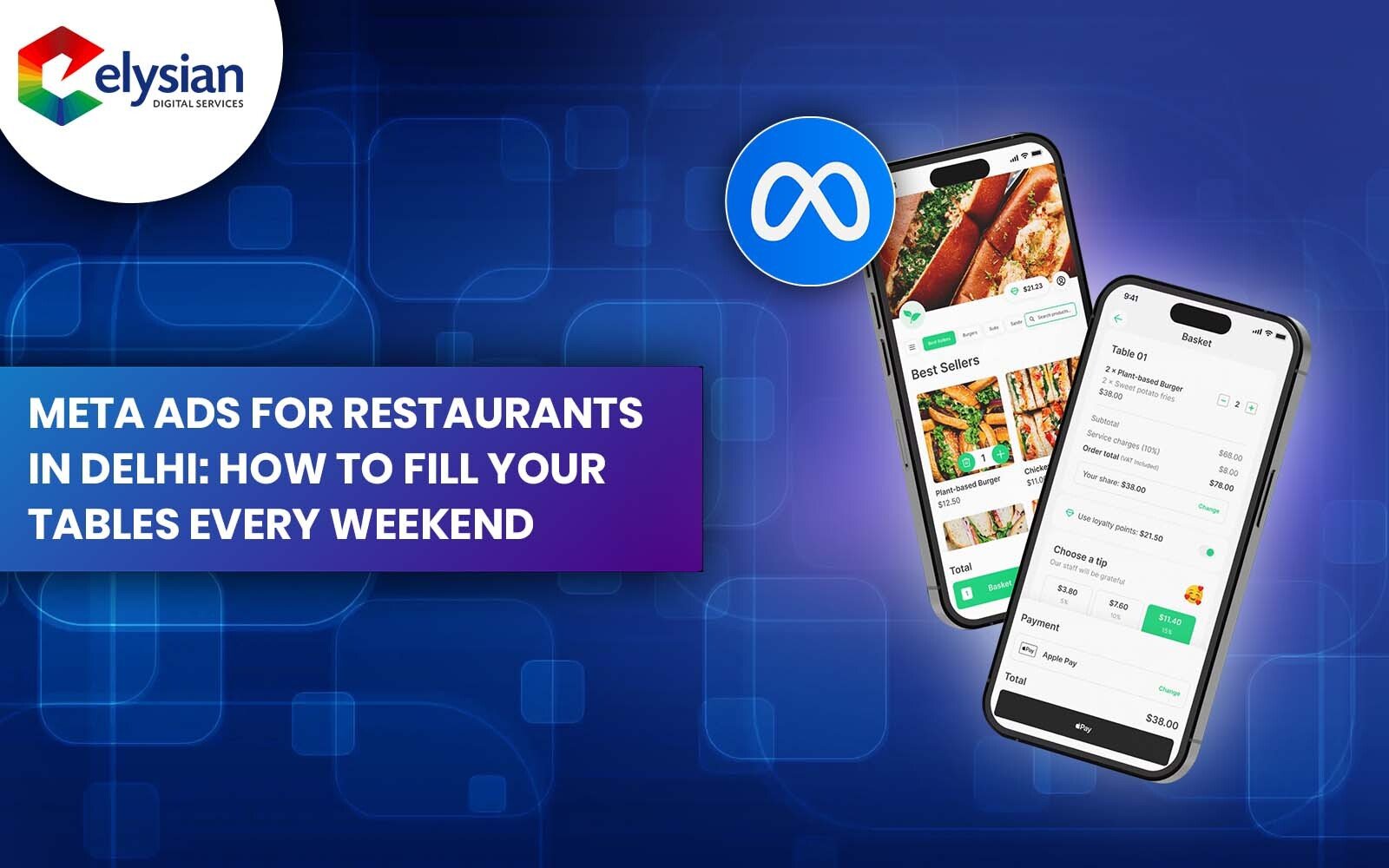
Meta Ads restaurants Delhi campaigns work by putting your food, offers, and availability in front of people nearby on Facebook and Instagram, the two places Delhi diners already spend time deciding where to eat this weekend. Whether a campaign actually fills tables depends on more than the ad itself: location targeting, the strength of the offer, creative quality, audience selection, budget, how easy it is to book, and whether you can track what happened after someone clicked. Get those right and Meta Ads can become a repeatable way to generate weekend demand rather than a one-off boost.
Yes, when the targeting, offer, and creative are aligned, Meta Ads can put your restaurant in front of people near your location who are likely to be planning where to eat or drink. Facebook and Instagram let advertisers reach people based on location radius, age, interests, past engagement with your page or content, and behavior signals available through Ads Manager. For restaurants, this matters because dining decisions are often made close to the moment of visiting, someone scrolling Instagram on a Thursday evening deciding where to go on Saturday is a realistic scenario these platforms are built to reach.
Restaurants are particularly well suited to paid social because the product is visual. A plate of food, a Reel of a dish being plated, a carousel of your interiors, or a Story announcing a weekend offer all communicate more in three seconds than a text ad ever could. This is why food photography, short-form video, event promotion, new menu launches, weekend dining pushes, and occasion-based campaigns (birthdays, anniversaries) tend to outperform generic brand-awareness posts for restaurants specifically. Local discovery, someone who has never heard of your restaurant seeing it for the first time because they live or work nearby, is one of the more distinct advantages Meta Ads offer over search-based advertising.
A restaurant campaign is judged by five factors working together: location, timing, occasion, offer, and creative. Get one wrong and the other four cannot fully compensate. A beautifully shot Reel with weak targeting reaches the wrong people; a strong offer with poor creative gets scrolled past; perfect targeting with no clear occasion (why should someone come this weekend specifically) results in low urgency.
Delhi adds its own layer of complexity because demand is genuinely neighborhood-specific. A cafe near an office cluster sees very different weekday and weekend patterns than a restaurant in a primarily residential catchment. Campaigns aimed at date-night audiences behave differently from those aimed at family dining or group celebrations. A few considerations worth building into strategy rather than assuming:
None of this replaces testing. Delhi's neighborhood-level variation means assumptions about "who eats where" should be treated as a starting hypothesis, not a fixed rule, and adjusted based on what the campaign data actually shows.
There is no single fixed price for Meta Ads in Delhi, costs depend on your restaurant category, audience size, competition, and objective, but a small restaurant can typically start testing with a monthly media budget in the ₹20,000–₹40,000 range. Larger or multi-location restaurants planning for consistent bookings and events often plan for ₹50,000 and above per month. These are illustrative planning ranges, not fixed market rates, and actual results vary by campaign.
| Restaurant Type | Suggested Test Budget | Monthly Media Budget | Main Objective |
|---|---|---|---|
| Small cafe | ₹15,000–₹25,000 | ₹20,000–₹40,000 | Footfall / offers |
| Casual restaurant | ₹20,000–₹40,000 | ₹30,000–₹60,000 | Bookings / enquiries |
| Premium restaurant | ₹30,000–₹60,000 | ₹50,000–₹1,00,000+ | Reservations / events |
| Multi-location restaurant | ₹50,000+ | ₹75,000–₹2,00,000+ | Location-level acquisition |
A few cost components are worth separating clearly, because they are often bundled together in restaurant owners' heads and shouldn't be:
Discounts and offers also affect the economics on the other side: a 20% off offer that drives bookings but erodes margin needs to be evaluated against the actual revenue and repeat-visit value it generates, not just the number of redemptions.
Your campaign objective should match what you actually want someone to do after seeing the ad, not a generic "more awareness" goal. Meta Ads Manager objectives map to real restaurant actions in a few distinct ways.
Drive traffic directly to a reservation page, a booking platform, a WhatsApp chat, or a phone number, depending on which channel your restaurant actually monitors and responds to quickly. If your team checks WhatsApp faster than a contact form, route the ad there instead of forcing an unfamiliar step.
Offer-based campaigns paired with tight local targeting tend to work best here, a limited-time weekend offer, shown to a realistic radius around your restaurant, with a clear reason to visit this weekend rather than "sometime."
Live music nights, brunches, DJ nights, special menus, festival dining, and occasion-specific events (Valentine's Day, Mother's Day, New Year's) are natural fits for Meta Ads because they have a hard deadline, which creates real urgency rather than manufactured urgency.
WhatsApp can be more practical than a landing page when your booking process genuinely involves back-and-forth, confirming table size, checking availability, or discussing a private event. It removes a form-filling step that adds friction for a decision people often want to make quickly. None of these objectives guarantee results on their own; they simply align the campaign mechanics with what you actually want to happen next.
Start with a geographic radius around your restaurant and layer in signals rather than trying to target broadly and hoping the algorithm figures out the rest. Practical building blocks include:
Meta's available targeting options change periodically, so campaign setup should always be checked against the current Ads Manager interface and Meta's advertising policies rather than assumptions carried over from an older campaign. Targeting should never be built around discriminatory categories, Meta's own advertising policies restrict this, and it's also simply not useful for a restaurant trying to reach genuine local demand.
Usually no, most restaurants get better results from a realistic catchment area than from city-wide targeting. Delhi is large enough that a diner on the opposite side of the city is unlikely to make a special trip for a casual meal, so spending budget reaching them is typically inefficient.
The right radius depends on:
A neighborhood cafe may focus almost entirely on nearby residential and office pockets, while a destination fine-dining restaurant with a distinct concept can often justify a much wider radius, since people are willing to travel specifically for that experience. Exact travel behavior varies by individual, so treat radius decisions as a testable hypothesis and refine using actual campaign data.
Short-form video tends to perform well for restaurants because it can show food preparation, plating, ambience, and the overall experience in a way a static image can't. A 10–15 second Reel of a signature dish being finished at the table, or a quick walkthrough of a weekend brunch spread, communicates more than a caption ever could.
Useful for showing multiple dishes, menu highlights, restaurant interiors, or breaking down offer details across several cards, for example, one card for the offer, one for the menu highlight, and one for the booking CTA.
Well suited to limited-time offers, weekend reservation pushes, event promotion, and flash promotions, since Stories carry a natural sense of immediacy and are often checked more frequently than the main feed.
Still effective when photography quality is genuinely high, a well-lit, well-composed image of a signature dish can outperform mediocre video. The format matters less than execution quality; a well-shot static image will usually beat a poorly shot Reel.
Below are sample ad angles built around common restaurant scenarios. These are illustrative examples, not guarantees of specific outcomes.
1. Weekend Dining
2. Couple / Date-Night
3. Family Dining
4. Limited-Time Offer
5. Event Promotion
Strong photography does not guarantee conversions, a visually excellent ad can still fail if the offer, audience, or follow-through breaks down anywhere in the chain. Common failure points worth checking before assuming the creative is at fault:
Any one of these can undo good photography. This is usually the first place to look when an otherwise well-produced campaign isn't converting.
A structured funnel gives each stage of the campaign a clear job rather than expecting one ad to do everything at once.
Stage 1 Awareness: Reels, video, high-quality food visuals, and ambience shots to introduce your restaurant to people who haven't seen it before.
Stage 2 Consideration: Menu highlights, reviews where permitted by platform policy, offers, social proof, and signature dishes to move interested viewers closer to a decision.
Stage 3 Conversion: Direct, low-friction paths to reservations, WhatsApp, phone calls, or a booking page, this stage should have the fewest steps possible.
Stage 4 Retargeting: Re-engage website visitors, people who engaged with your social content, video viewers, and other permitted first-party audiences with a more direct offer or booking push.
Every stage that involves customer data, website visitor lists, uploaded customer lists, or engagement audiences, should be built with appropriate consent and in line with Meta's platform policies and applicable privacy requirements, rather than assumed to be automatically compliant.
This is an illustrative campaign framework, not a schedule every restaurant will follow exactly, actual pacing should adjust to real performance data.
Budget allocation should shift based on what's actually converting, but a common starting framework for a ₹30,000 monthly media budget (illustrative example) looks like:
These percentages are a starting point, not a universal rule. A restaurant with a strong existing follower base might justify a higher retargeting share; a brand-new location might need to weight prospecting even more heavily in its first few months.
Likes, comments, reach, and follower growth are not reliable indicators of whether a restaurant campaign is working, bookings, enquiries, and revenue are. The metrics that actually matter for a restaurant include:
There's an important distinction between ad platform metrics (impressions, clicks, engagement, what Meta reports inside Ads Manager) and actual restaurant revenue (what shows up in your POS or booking system). A campaign can look excellent by platform metrics and still fail to move real bookings if that second layer of tracking isn't connected.
At minimum, a restaurant running Meta Ads should have the Meta Pixel installed on any booking or contact page, alongside consistent UTM parameters on every campaign link so traffic sources are distinguishable in Google Analytics. Beyond that:
All tracking implementation should respect applicable privacy requirements and Meta's platform policies, this includes appropriate consent mechanisms for any data collection tied to advertising.
Meta Ads and Google Ads solve different problems for a restaurant, one creates demand, the other captures it.
| Factor | Meta Ads | Google Ads |
|---|---|---|
| Discovery | Strong | Moderate |
| Visual storytelling | Strong | Limited |
| Existing demand | Creates demand | Captures demand |
| Food visuals | Excellent | Limited |
| Local intent | Strong | Very strong |
| Offers/events | Strong | Strong |
| Search-driven bookings | Limited | Strong |
Meta Ads are stronger for introducing your restaurant to people who weren't actively searching for it, someone scrolling Instagram who wasn't planning to eat out until your ad prompted the idea. Google Ads are stronger for capturing people already searching with intent, someone typing "restaurants near me open now." Many Delhi restaurants get more value from running both platforms together than from treating them as an either/or decision, since they address different points in the customer's decision-making process.
Organic Instagram content builds long-term audience and brand familiarity, but its reach is inconsistent and depends heavily on the platform's algorithm at any given time. Paid distribution through Meta Ads guarantees your content reaches a defined audience within a set budget and timeframe, which organic posting alone cannot promise.
Paid promotion makes the most sense when you need a specific, time-bound outcome, filling this weekend's tables, promoting a one-off event, or testing which creative resonates before investing more in a direction. Organic content, meanwhile, is where you build the audience, reviews, and creative library that paid campaigns eventually draw from. The two work best as complementary, not competing, efforts.
Agency support becomes more useful once a restaurant's advertising needs go beyond what one person can manage consistently alongside running the business itself. This is typically the case when a restaurant:
An agency isn't a requirement for every restaurant. A single-location cafe running a modest, occasional campaign can often manage this internally with some learning. The decision usually comes down to time, complexity, and whether the internal team can keep testing and optimizing consistently.
For restaurants that want structured, ongoing campaign management, our approach starts with understanding your realistic catchment area, price point, and booking process before a single ad is built. From there, campaign work typically covers Meta Ads strategy, campaign setup, audience research, creative testing across formats, retargeting structure, conversion tracking, performance reporting tied to bookings rather than reach, and, where useful, integration with paid search so Meta and Google campaigns work together rather than in isolation.
We look at bookings and enquiries rather than vanity metrics when reporting on a restaurant campaign, because likes and reach don't pay rent. If you're evaluating whether to bring in outside support for your restaurant's Meta Ads, our PPC and paid advertising services page covers how we structure campaign management, and you can learn more about our broader approach at Elysian Digital Services.
How much do Meta Ads cost for restaurants in Delhi?
There's no single fixed cost, small restaurants typically start testing with ₹20,000–₹40,000 per month in media spend, while larger or multi-location restaurants often plan for ₹50,000 and above, separate from any agency management or creative production fees.
Are Facebook Ads or Instagram Ads better for restaurants?
Instagram generally performs better for visual, food-led content given its format and audience behavior, but Facebook can still be useful for reaching a broader or slightly older local audience, and most restaurant campaigns run across both placements together through Meta Ads Manager.
How much should a small restaurant spend on Meta Ads?
A small restaurant can typically start testing with ₹15,000–₹25,000 as an initial test budget, scaling toward ₹20,000–₹40,000 per month in ongoing media spend once early results show which creative and targeting combinations work.
Can Meta Ads increase restaurant bookings?
Yes, when targeting, offer, and creative are aligned with a clear booking path — but results depend on execution quality, and no campaign can guarantee a specific booking volume.
How far should a restaurant target customers around its location?
It depends on restaurant category and price point, a neighborhood cafe usually needs a tighter radius, while a destination fine-dining restaurant can often justify a broader one, and the right distance should be refined using actual campaign data rather than assumed upfront.
What type of restaurant ads work best on Instagram?
Short-form video, particularly Reels showing food preparation or ambience, tends to perform well, though high-quality static images and carousels showing menu highlights or offers can also convert strongly.
Should restaurants run Meta Ads every day?
Most restaurants benefit from always-on retargeting combined with periodic prospecting pushes timed around weekends or events, rather than either running ads constantly with no variation or only running them sporadically.
How do I track restaurant bookings from Meta Ads?
Set up the Meta Pixel on your booking or contact pages, use consistent UTM parameters on every ad link, connect Google Analytics, and where possible, link your booking system or CRM so a click can be followed through to an actual reservation.
Should restaurants use Meta Ads or Google Ads?
Many restaurants benefit from using both, Meta Ads are stronger for creating demand among people not actively searching, while Google Ads are stronger for capturing people already searching for a place to eat nearby.
Can Meta Ads promote weekend restaurant offers?
Yes, offer-based campaigns paired with tight local targeting and a clear deadline are one of the more effective uses of Meta Ads for restaurants specifically.
How long should I test a restaurant Meta Ads campaign?
A minimum test period of one to two weeks is generally needed to gather enough data on creative and audience performance before drawing conclusions, though this can vary with budget size and how quickly the campaign accumulates engagement.
Do I need an agency to run Meta Ads for my restaurant?
Not always, a single-location restaurant with a modest budget can often manage this internally, but agency support becomes more valuable as location count, budget, and tracking complexity increase.
Learn more about the expert behind this content and their industry experience.
Deepa is a Social Media Strategist at Elysian Digital Services, specialising in Social Media Marketing, Meta Ads, content strategy, and audience engagement. She creates data-driven campaigns that strengthen brand visibility, drive meaningful engagement, and deliver measurable business growth across digital platforms.
Discover tailored digital marketing solutions designed to boost your visibility, increase ROI, and support your business growth. Connect with our experts today.
Get In Touch